
AI in the workplace is no longer something only large enterprises are experimenting with. It is already showing up inside small and midsize businesses every day. In many cases, it arrives quietly. A team member uses a public AI chatbot to draft an email. Someone pastes notes into an AI tool to summarize a meeting. A manager asks a free tool to rewrite a proposal or organize a spreadsheet. This kind of unapproved, unmonitored use is often called Shadow AI, and it is becoming a real issue for SMB data protection. Microsoft has reported that AI use at work is already widespread, including significant “bring your own AI” behavior among employees. (Kateva, Inc.)
That does not mean AI is a bad thing. Used well, it can absolutely help your business move faster, improve consistency, and reduce repetitive work. But like many tools in business technology, the value depends on how it is deployed. You do not need to panic, and you do not need to ban AI outright. You do need to understand the difference between casual public AI use and a secure, company-managed approach.

Let Kateva help you keep your data secure while you advance with AI!
What Shadow AI Really Means for Small Businesses
For most SMBs, Shadow AI does not start with bad intentions. It starts with convenience.
An employee wants to save time. A manager wants to clean up a rough draft. Someone in operations wants help summarizing a long email chain. The tool is easy to reach, it feels private, and it gives a quick answer. That is exactly why Shadow AI spreads so fast.
The problem is that many business owners assume AI use is happening only inside approved systems. In reality, your team may already be using public tools outside your normal IT oversight, outside your security controls, and outside your written policies. That creates a gap between how protected your business appears to be and what is actually happening day to day.
For small business cybersecurity, that gap matters. A lot.
The Core Risk: Public AI Is Not the Same as Managed AI
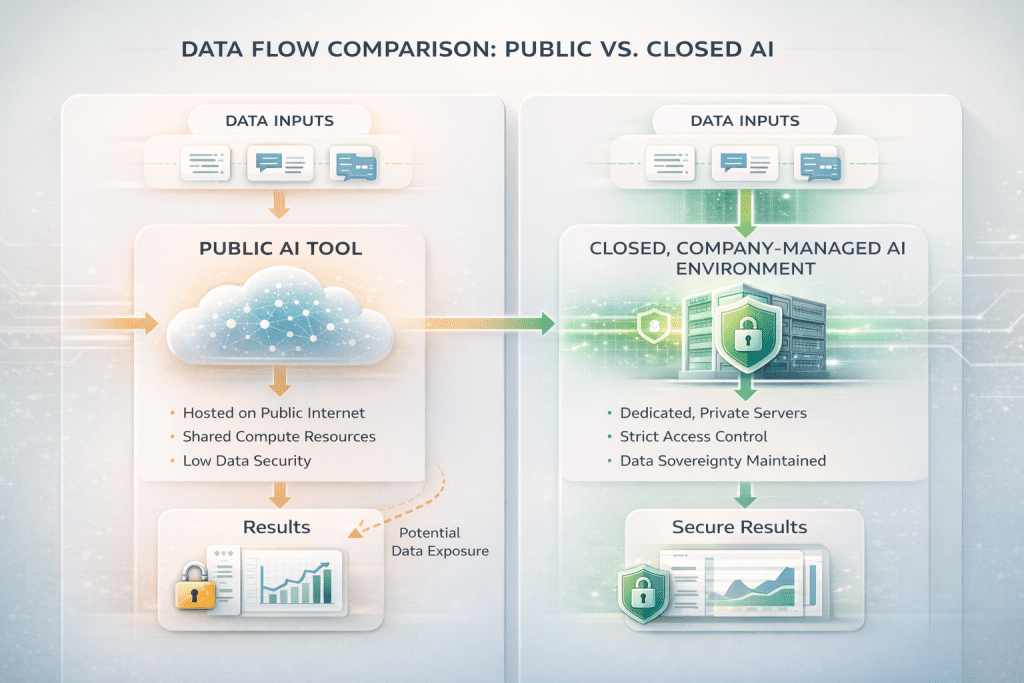
This is the part every SMB owner and manager needs to understand clearly: a public AI account is not the same thing as a business-grade AI environment.
With many consumer or public AI tools, what a user types may be retained, reviewed, or used to improve the service depending on the provider, the product, and the settings in place. OpenAI, Google, and Anthropic all distinguish between consumer products and business offerings, and they provide different rules and controls depending on which version you are using. (Kateva, Inc.)
That means if an employee enters sensitive business information into a public tool, they may be moving that information outside your approved business environment.
That information could include:
- customer names and contact details
- financial records or payroll information
- contracts and pricing
- internal procedures and SOPs
- proprietary workflows
- source code or technical documentation
- protected health or legal information
- vendor details and account credentials
Even when nobody is trying to do anything reckless, that is still a serious SMB data protection problem.
By contrast, properly configured business-grade AI tools can offer stronger privacy protections, admin controls, retention settings, identity management, and data handling terms that are designed for organizations. Business offerings from major vendors also commonly state that customer data is not used to train their models by default in those managed environments. (Kateva, Inc.)
That is the difference between experimenting casually and pursuing safe AI adoption.
Call now to discuss safe AI setup!
Three Shadow AI Risks SMBs Cannot Ignore
You do not need to imagine extreme scenarios to understand the danger. The risks are practical and very real for day-to-day operations.
1. Accidental data exposure
This is the most immediate risk. An employee copies and pastes information into a public tool without realizing that the content should never leave approved systems. That could be a customer record, a contract, a pricing sheet, or a support log.
The intent may be innocent. The result can still be harmful.
2. Loss of intellectual property
For many SMBs, your competitive edge is not a patented invention. It is your process. It is your internal know-how, your service model, your proposal structure, your workflow, or the way your team solves client problems. When that information is fed into unvetted public AI tools, you lose control over something that took years to build.
3. Compliance and contractual problems
If your business handles regulated data or works under client confidentiality obligations, unmanaged AI use can quickly create legal and compliance headaches. That may include privacy rules, industry requirements, or simple contractual promises you have already made to your customers. NIST and other major standards bodies continue to emphasize that generative AI risk management needs to be aligned with privacy, security, and compliance obligations. (Kateva, Inc.)
4. No visibility for leadership
One of the hardest parts of Shadow AI is that leaders often do not know it is happening. If you cannot see which tools are being used, what data is being entered, or who is using them, you cannot build a real policy around them.
That leaves your business reacting after the fact instead of putting guardrails in place up front.
The Good News: AI Can Absolutely Help Your Business
There is a reason employees keep reaching for AI tools. They can be genuinely useful.
Used responsibly, AI in the workplace can give SMBs real advantages without putting business data at unnecessary risk.
1. Better productivity on repetitive tasks
AI can help with first drafts, meeting recaps, internal documentation, brainstorming, data cleanup, and other routine work. That gives your team more time to focus on customer service, strategy, and revenue-producing work.
2. Safer use of company knowledge
When AI is deployed through approved, business-grade tools, you can often keep the work inside a more controlled environment. That means your team can still benefit from summarization, automation, and search without casually exposing sensitive information.
3. More consistent operations
AI can support safer operational workflows when it is tied to approved systems and governed correctly. That might include help desk support, standardized communications, internal knowledge retrieval, or document assistance. The key is that it is being used inside a framework you actually control.
4. A realistic path forward for growing SMBs
Small businesses do not always have the luxury of large internal IT and compliance teams. Managed AI deployment gives you a way to adopt new tools without adding unmanaged risk at the same pace.
What Safe AI Adoption Actually Looks Like
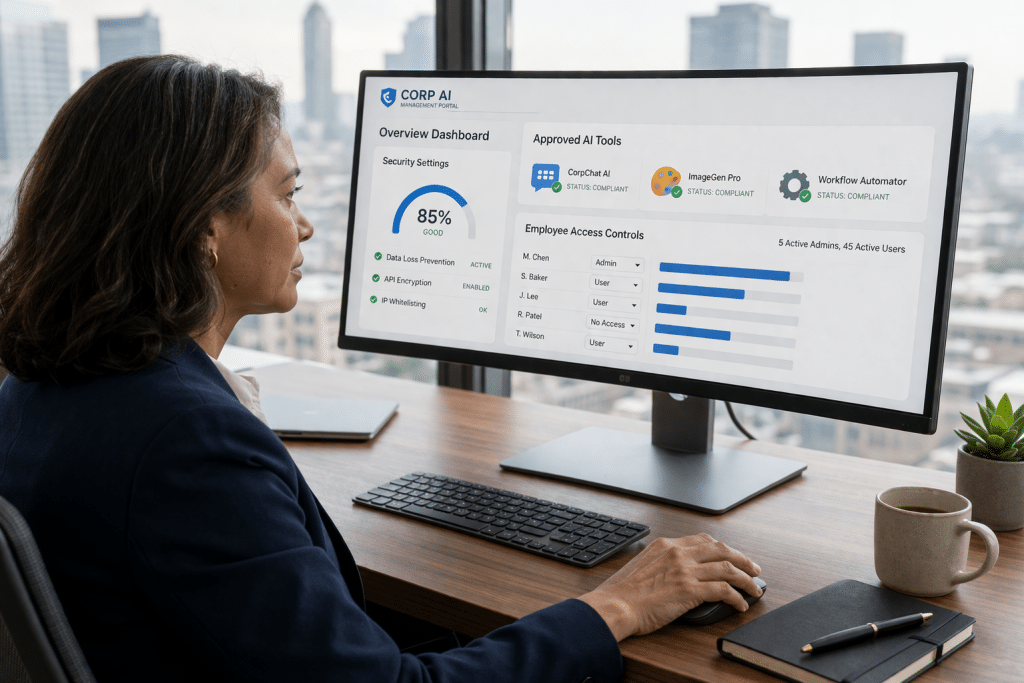
For most SMBs, safe AI adoption is not about saying yes or no to AI. It is about building a practical structure around it.
That usually includes:
- choosing business-grade AI licenses instead of relying on personal accounts
- reviewing vendor privacy and training settings
- setting data handling rules for employees
- limiting what types of information can be entered into AI tools
- using identity controls and admin oversight
- training your team in plain language
- auditing who is using what
This is where many businesses get stuck. The technical side can become complicated quickly. A company may need to compare plans, review privacy settings, configure secure environments, connect the right systems, and train staff so they understand both the benefits and the boundaries.
You do not need to become an AI governance expert to do this well. But you do need an expert in your corner.
That is where managed IT services make a difference. A partner like Kateva can help your business move from unmonitored AI use to a more secure and intentional approach. That includes helping you evaluate business licenses, configure safer environments, set policies your team will actually follow, and reduce Shadow AI risks before they become bigger problems.
Your Next Steps
If you are not sure where to begin, start with three practical actions this week:
- Ask your team what AI tools they are already using at work.
- Set a simple rule about what information must never be entered into public AI tools.
- Work with a trusted IT partner to evaluate secure options for safe AI adoption.
You do not need to lock everything down so tightly that nobody can work. You do need to close the gap between how AI is being used and how your business is protected.
AI in the workplace is not going away. For SMBs, the smartest path is not fear and it is not blind adoption. It is a clear, managed plan that gives your team the benefits of AI without putting your data, your systems, or your customer trust at risk.