
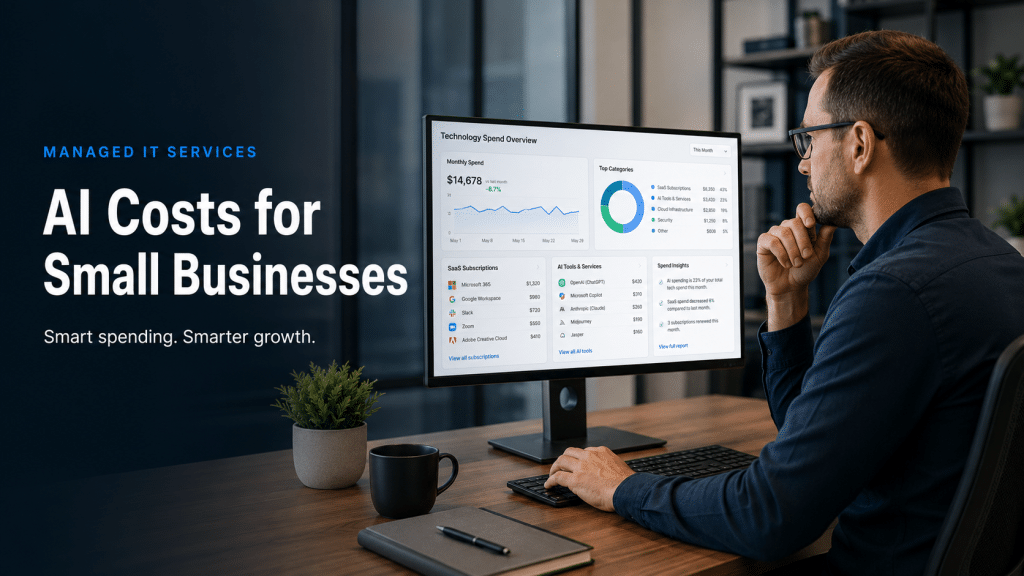
AI can be a useful tool for small businesses. It can help a team move faster, clean up rough drafts, summarize information, support coding work, and take some of the repetition out of daily operations. But many companies are also learning that the cost of AI is not always as simple as the price shown on the subscription page.
At Kateva, we look at AI the same way we look at other business technology. It can create real value when it is managed well. It can also become expensive when it spreads across the company without a clear plan.
That does not mean businesses should avoid AI. It means AI needs the same kind of oversight as software, cloud services, cybersecurity tools, and other technology expenses. A tool that starts as a small convenience can become a larger cost when more employees begin using it, when teams add overlapping tools, or when AI is connected into daily workflows behind the scenes.
Make AI more useful, secure, and cost-conscious with help from Kateva.
The monthly subscription is only part of the real cost
Most businesses start with the number they can see. An AI tool might cost a certain amount per user each month, and that makes the budget feel simple. If five people need access, the company can estimate the cost and decide whether the tool is worth trying.
In real use, AI spending often becomes less tidy.
A business may start with one tool for writing or research. Then a meeting platform adds AI summaries. A project management tool introduces an AI assistant. A software platform the company already uses starts offering AI features as a paid add-on. None of these changes may seem dramatic on its own. The cost problem shows up later, when the company realizes AI is now spread across several tools, teams, and accounts.
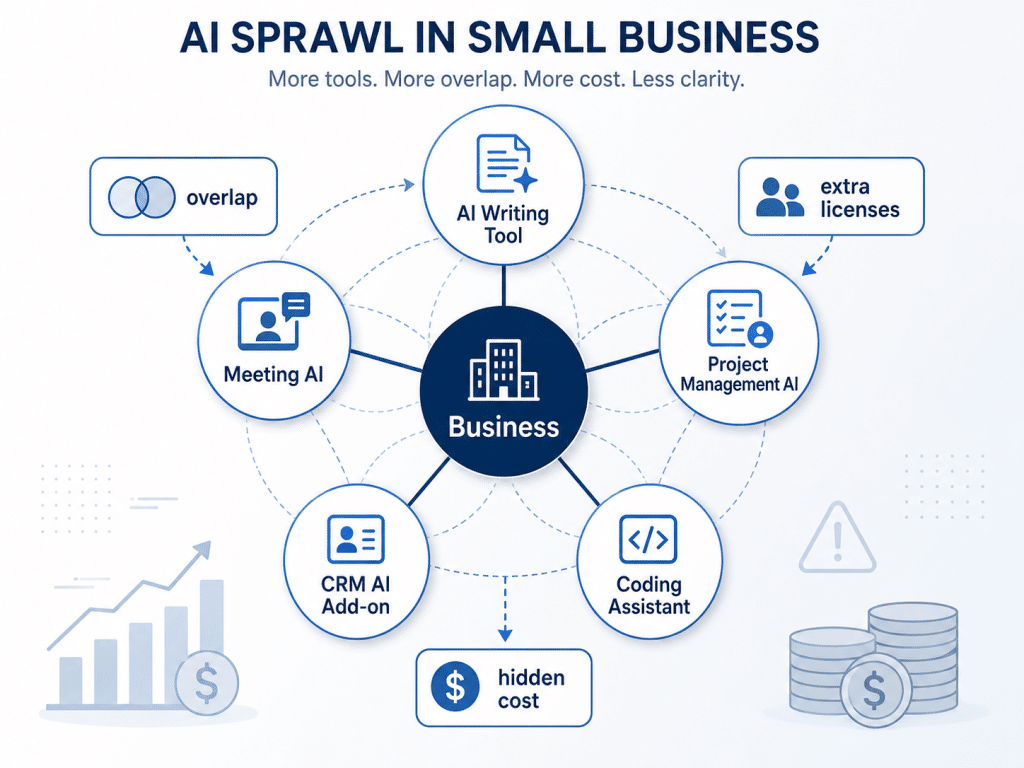
This is a familiar problem in a new form. Many businesses have already dealt with software sprawl, where different departments adopt different tools without one clear view of the whole environment. AI makes that easier because it is quick to test and often useful right away.
The business impact is simple: when no one has a clear picture of AI usage, it becomes harder to know which tools are helping, which ones overlap, and which ones are quietly adding cost.
AI cost and AI security are connected
Kateva has already written about safe AI adoption for SMBs, especially the risk of employees using public or unmanaged AI tools for business work. That article focuses on Shadow AI, data exposure, and the difference between casual AI use and a company-managed approach.
Cost belongs in that same conversation.
When employees adopt AI on their own, the business may not know what tools are being used or whether those tools are approved. A manager may see the value in an AI note-taking tool. A team member may use a chatbot to speed up emails. A department may add an AI-powered feature inside a platform they already use. These choices may come from good intentions, but they still create a gap between what the business thinks it is managing and what is actually happening day to day.
For a small business, the answer does not need to be complicated. You do not need to shut down every new idea or create a long approval process for every tool. But you do need enough visibility to make practical decisions. Some AI tools may be worth keeping. Some may need better settings. Others may be adding cost without enough business value.
Call Kateva to review where AI tools may be adding hidden cost or risk.
API-based AI costs are where surprises happen
Some AI use is easy to see. An employee logs into a tool, types a question, and receives an answer. The company may still need to manage the account, but the usage feels visible.
Other AI use happens in the background. This is often where companies get surprised.
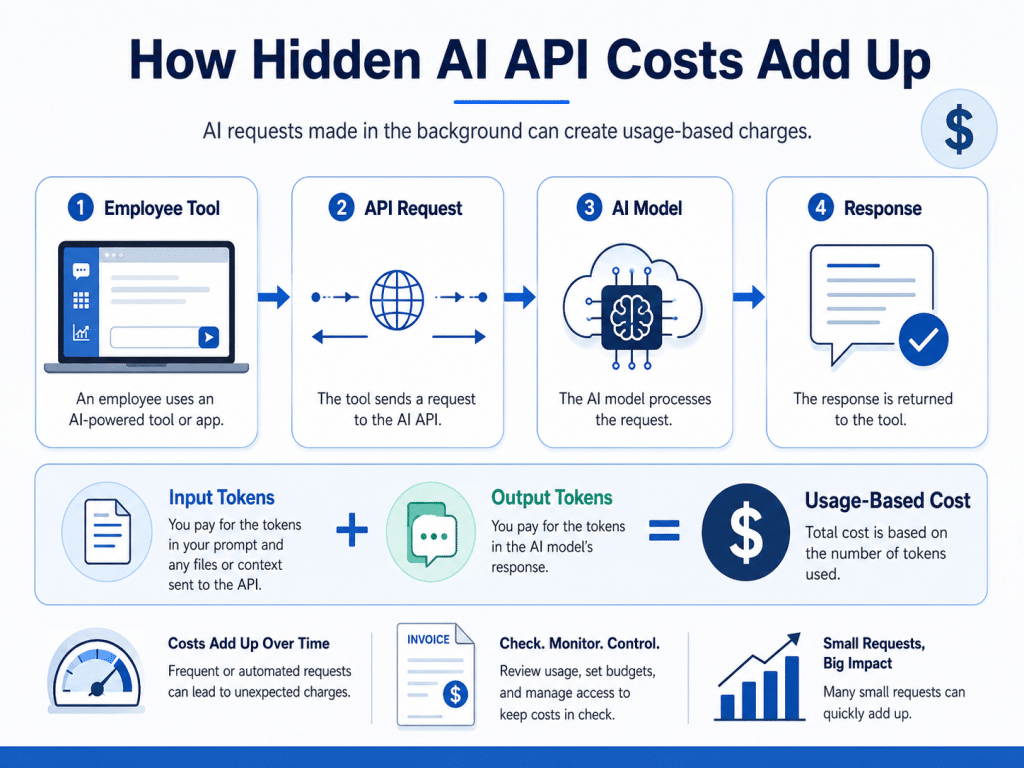
An API is simply a way for one system to talk to another system. In an AI setting, that might mean a helpdesk tool sends a ticket to an AI service for a summary. A workflow may ask AI to classify a customer request. A coding tool may send context to an AI model while a developer is working.
To the employee, it may feel like they are using one familiar tool. Behind the scenes, that tool may be making AI requests that create usage-based cost.
Kateva worked with a group using AI as a coding tool, and this became very real for them. They already had access to an AI tool through a subscription and expected their normal use to be covered. What they did not realize was that using the AI integration from their main coding environment, VS Code, could create API token costs outside the regular subscription.
Once they understood where the extra cost was coming from, they adjusted how they used the integration. They reduced unnecessary API calls and changed their workflow so the subscription-covered tool handled more of the work without creating added usage charges.
That is the kind of practical issue many businesses miss at first. The question is not only, “What does this tool cost?” It is also, “How is this tool being used?”
What is a token?
A token is a small piece of text that an AI system reads or writes. It might be a short word, part of a longer word, punctuation, or even spacing. Business owners do not need to count tokens manually, but it helps to understand that many AI systems use tokens to measure usage.
OpenAI explains that tokens are the building blocks of text its models process, and that spaces, punctuation, and partial words can all contribute to token counts. It also explains that token usage can include input tokens from the request and output tokens generated in the response.
The plain-English version is this: the AI has to read what you send it and write something back. Both sides of that exchange can create usage.
A short question with a short answer may not use much. A longer workflow can use much more, especially if the AI is reading documents, following detailed instructions, using background context, or producing a long response. If that workflow runs many times a day, the cost can add up faster than expected.
This is why API-based AI spending can be hard to estimate before a company sees real usage. The cost depends on the tool, the model, the length of the requests, the length of the responses, and how often the workflow runs. OpenAI’s API pricing shows costs by input, cached input, and output tokens, and notes that some tool-related usage is also billed based on model rates.
For an SMB, the point is not to become a developer or pricing expert. The point is to know that AI usage can keep generating cost every time it reads, processes, acts, or responds.
Larger companies are paying attention too
This issue is not limited to small businesses. Business Insider recently reported that Sam Altman said OpenAI’s top token user goes through about 100 billion tokens a month. The same report said Amazon shut down a token leaderboard, and Uber reportedly set token caps after AI spending became harder to justify.
Small businesses do not need to compare themselves to OpenAI, Amazon, or Uber. The useful lesson is much simpler: even large companies are paying closer attention to AI usage.
That should be a signal for SMBs. AI may be worth the investment, but it should not be invisible. If employees are using AI tools every day, if AI is being added into workflows, or if tools are connected through APIs, the business needs a way to review the cost and decide whether the value is there.
Before expanding AI, understand what is already in place
A business does not need a massive AI strategy document to get started. A practical review is often enough.
Start by finding out how AI is already being used. Some of that usage may be obvious, like paid AI subscriptions. Other usage may be less visible, like AI features built into software the company already uses. It may also be happening through personal accounts or integrations that leadership has not reviewed.
From there, the business can make better decisions. A tool that saves a team hours every week may be worth keeping. A tool that duplicates another platform may not be. A subscription that only one person uses occasionally may need to be downgraded or removed. An API-based workflow may need usage limits or a different process so the cost stays reasonable.
The most important question is not whether AI is exciting. The question is whether it is helping the business in a way that justifies the cost.
How an MSP can help manage AI cost
This is where an MSP can help.

Kateva’s Managed IT Services are built around helping small businesses manage IT support, cybersecurity, cloud services, remote and onsite support, IT strategy, and related technology needs. As AI becomes part of everyday business software, it naturally becomes part of that larger technology picture.
A managed IT partner can help a business see what tools are already in use and where spending may be leaking out through overlap, unused licenses, unmanaged accounts, or usage-based billing. They can also help review whether AI tools are being used safely and whether the right controls are in place.
That matters because AI cost and AI security often show up together. A tool that looks inexpensive may create risk if employees are entering company information into unmanaged accounts. A tool that costs more may be worthwhile if it is secure, properly configured, and clearly tied to business value.
The goal is not to slow down useful AI adoption. The goal is to make AI easier to manage.
AI can be valuable, but it needs management
AI is becoming part of normal business technology. For many SMBs, it will help employees work faster and make better use of their time. But like any tool, it works best when there is a clear plan around it.
The businesses that get the most value from AI will not be the ones that try every new tool without oversight. They will be the ones that understand where AI fits, how it is being used, and whether the cost makes sense.
If your business is already using AI tools or planning to expand them, Kateva can help you review what is in place, identify cost risks, and build a more manageable approach. AI should be useful, secure, and cost-conscious — not another unmanaged expense hiding in your monthly technology bill.